
Well decked-out
The Nature of PEI by Gary Schneider
During Prince Edward Island winters, we often are desperate for a bit of colour, outside of the green of the spruce trees and the white of the snow. That’s why we get so excited about seeing the orange fruit of a Winterberry Holly, or the large red seed heads of a Staghorn Sumac.
It is why the flashes of an Evening Grosbeak or, more rarely, a Northern Cardinal get the neighbourhood excitedly talking.
Yet one of my favourite feeder visitors is mostly just black and white. Hard to get excited about that, right? No red patch on the head like a male Downy Woodpecker. No rusty feathers like we see on a Red-breasted Nuthatch. Nothing as flashy as a Blue Jay.
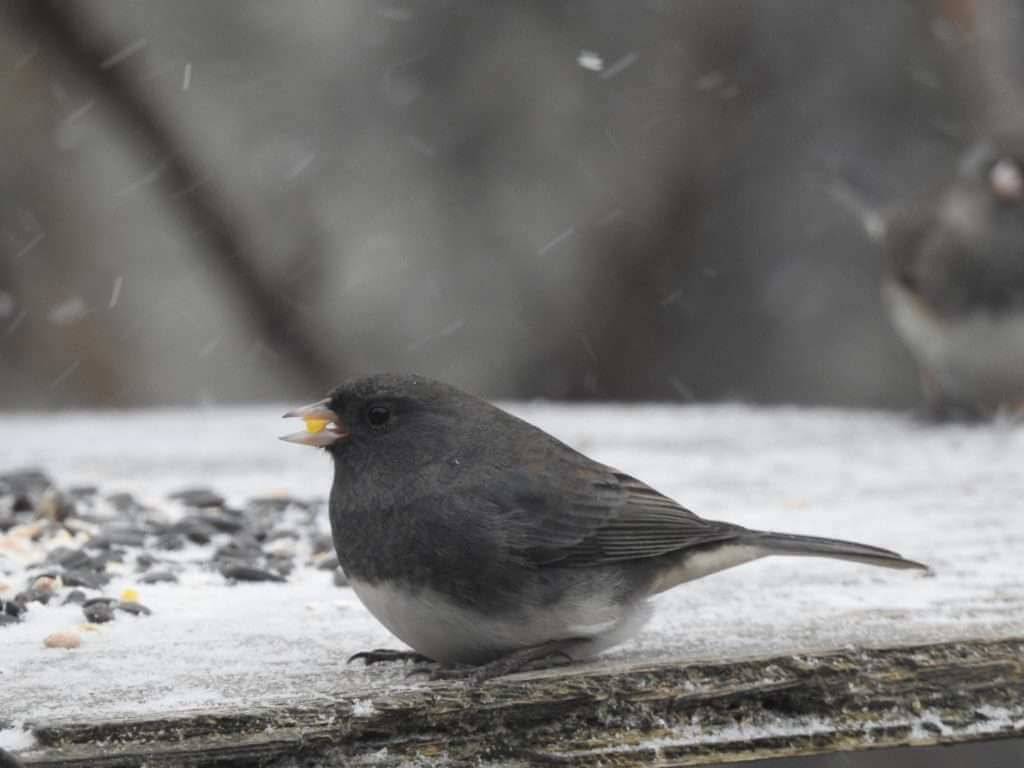
For the most part, the colours are simply black and white. Sometimes the feathers are more grey, or there is a bit of light brown. But really, when you look at a Dark-eyed Junco, that’s about it. Yet there is something about how it is decked out that makes me appreciate this frequent visitor to winter feeders. Generally dark above and light on the breast, this sparrow-sized bird can be found throughout the year in our province. It will migrate south late in the year, but others arrive here from more northerly areas.
There are six distinct populations of Dark-eyed Juncos in North American that include Slate-colored (in Eastern Canada), Oregon, Pink-sided, White-winged, Gray-headed, and Red-backed Juncos. In addition, there are 12 subspecies divided among these populations. This sounds way more confusing than it actually is. You just need to know a few key characteristics of this lovely bird to be sure that it is a junco.
One of the most distinctive signs of a Dark-eyed Junco is that the outer tail feathers are white. When taking off, the bird shows flashes of white along the tail. The small beak is slightly pinkish and the eye is indeed dark. It is sometimes seen in large numbers (up to twenty or more) but sometimes you just see two or three coming to feeders.
You’ll often find Juncos in mixed flocks that include Black-capped Chickadees and Red-breasted Nuthatches. They will travel together looking for seeds of all kinds. This is why you find them at houses with feeders—they don’t have to travel to seek out their food, it comes regularly at the same place. They are ground feeders and feed on platforms as opposed to tube feeders. While seeds are their primary source of food throughout the year, when they are raising young juncos take a lot of insects for the higher levels of protein.
Juncos nest on the ground, making the eggs and nestlings easy marks for predators such as Red Squirrels and Eastern Chipmunks. To combat excessive losses, the nests are usually quite well hidden. I have found them inside a hollow log lying on the ground, tucked into the moss beside a stump, underneath the lower branches of a spruce tree, or hidden in a planter outside a house. Even still, the predation levels are between 20 and 80 percent. They will often raise two broods of nestlings within a single year, laying 3–5 eggs each time.
Much like the Black-capped Chickadee, a Dark-eyed Junco is a bird that is commonly found in both wooded and residential areas across the province. Yet its commonness shouldn’t detract from its elegance. Instead, we should celebrate the fact that this lovely bird is willing to brave our winters and help keep us company.