
The Butcher Bird
The Nature of PEI by Gary Schneider
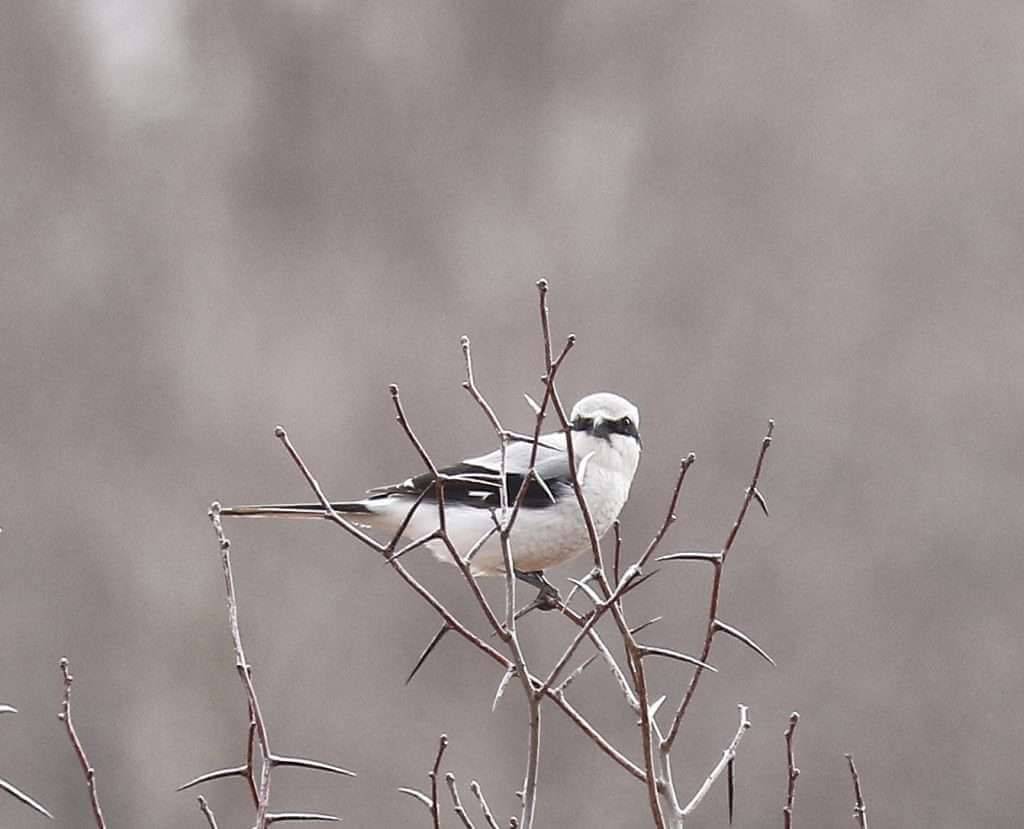
[Photo by Donna Martin]
The Northern Shrike is an uncommon species in Prince Edward Island. Known as a songbird for its lovely warbling call, it also has a reputation as a fearsome predator. This spring a friend and I took a trip to Greenwich National Park to see what birds might be around. We’d heard about a Northern Shrike in the area but it wasn’t until the end of our walk when we heard one singing.
We followed the call and came upon the bird singing from the top of a shrub in a regenerating field. It flew from speckled alder to willow and back, looking for prey. Make no mistake—this is as much a predator as any hawk or falcon.
About the size of an American Robin, an adult shrike is composed of shades of black and white. The wings are black, while the tail is black with white edging. It also has a distinctive black stripe through the eye that makes it appear to be wearing a mask. Younger shrikes have browner bodies and lack the mask.
All shrikes have strong, hooked bills that they use to capture prey—everything from grasshoppers and other insects to small birds, mice, and voles. They have an unpleasant habit—at least to my sensibility—of hanging food on the long thorn of a native hawthorn or even a barbed wire fence. Hence the nickname, Butcher Bird.
These are birds that I come across once or twice a year, despite being in appropriate habitats quite regularly. They are birds of open areas, especially ones with wires, fence posts, or shrubs to perch on. Rarely would you find them in a forest.
Prince Edward Island is part of their wintering ground. During the breeding season, you would have to visit the northern boreal forest to find this bird. And you won’t find it in a flock—it is a solitary bird that keeps its own company.
I’ve always been curious as to why they sing so sweetly. As they are on their winter grounds here, they aren’t trying to attract a mate. I had no idea why they would waste valuable energy by singing. It turns out that they are using their song to lure in prey. An American researcher set up an experiment to test his theory. He played tapes of Northern Shrike calls and monitored the responses by small birds. He also used the call of an American Robin as a control. More small birds responded to the shrike call than to the robin call. They came more quickly and more closely, and there were more of them. He watched as American Goldfinches and other small birds were attracted to the song, and witnessed several of them being chased and killed by the shrike. That really is one clever bird.
A good example of how things have changed in our treatment of birds stems from the 1870s. House Sparrows—native to Europe and Eurasia—were introduced in Brooklyn to control caterpillars on linden trees and to give settlers a taste of the homeland. Another genius idea, as now they are one of the most invasive birds in many places all around North America. The story goes that a warden was hired to shoot Northern Shrikes on the Boston Commons in winter, in order to protect the sparrows! I believe today that warden would be trying to get rid of the House Sparrows and leaving other birds alone.
We look for Northern Shrike every year and feel very fortunate to have found one.