
Our glorious newt
The Nature of PEI by Gary Schneider
Amphibians have always puzzled me. I learned to think of them as similar to those cars that could travel on both land and water, which seems like a handy skill to have. The word amphibian comes from the Greek amphibios, which means “living a double life.”This refers to the reliance on both aquatic and terrestrial habitats.
We have ten amphibians native to Prince Edward Island. The problem is, some of them closely follow the rules, while others do not.
Our five frogs—wood, tree, green, leopard, pickerel—all lay their eggs in water. The eggs turn into tadpoles and then morph into terrestrial creatures. All pretty standard, except that the tadpoles of green frogs take a second year to develop. This is why you see quite large tadpoles early in the year swimming with much smaller ones.
The American toad also falls in line, laying a long string of eggs in a variety of waterways that turn into tadpoles. After a while these climb out onto dry land, where they live until they are ready to lay eggs in water.
So far so good. Our two “mole” salamanders (common ones with quite flattened heads) are the spotted salamander and the blue-spotted salamander. I’ve ranted about names before, but in no logical universe should a salamander with bright yellow spots be called “spotted salamander” while one with blue spots has that distinction added to its name. But at least they both lay clusters of eggs in water, these hatch into aquatic babies, which in turn crawl up onto the land.
Our last two amphibians are the troublemakers. Red-backed salamanders never go into the water. They lay eggs under rocks or decomposing wood. The egg itself represents the aquatic stage. I remember looking at a cluster of eggs under a microscope and seeing eyes looking back at me as the young salamanders moved in the jelly-like eggs.
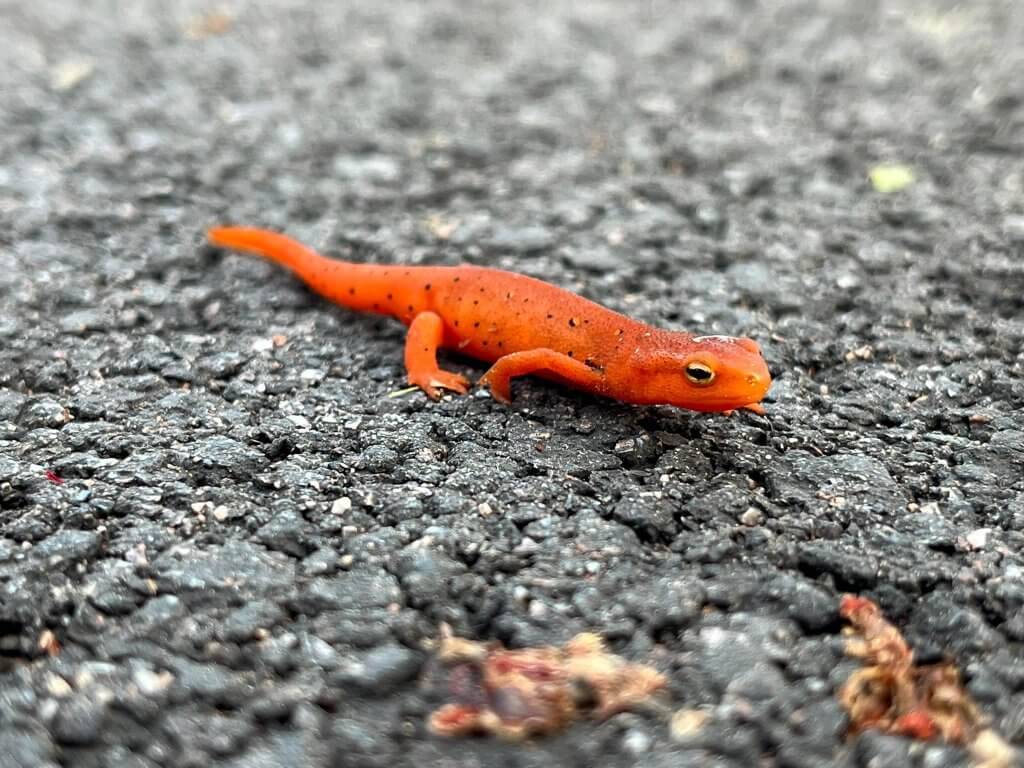
Last, but certainly not least, is the red-spotted newt. It is an especially interesting species, both for its beautiful red-orange colour and also its quite unique life-cycle. For anywhere from two to seven years after emerging from water, this amphibian not only changes its habitat, but also its name. During this stage, it is known as an eft and can grow to about eight centimetres in length. Once it enters its aquatic stage, this newt loses its lovely colouration, becoming more green and grey and living in shallow, slow-moving waters.
Newts can lay between 80 and 450 eggs in the spring and can live up to 15 years. I have found efts in compost piles and moist straw bales, while the aquatic newts are relatively common in many Island waterways.
Many visitors to Macphail Woods have told me that they have never seen a newt. And that is understandable as we often avoid those damp, dark places where newts and efts are usually found. In general, we see lots of spotted salamanders and a few blue-spotted salamanders. But if we know where to look, we can find large amounts of red-backed salamanders just by turning over rotting logs in the woods, and also many red-spotted newts in shallow pools or nearby forests.
Just because we don’t commonly see a certain species doesn’t mean it isn’t around. The barred owl is just one example. And conversely, we may think a population is healthy because something is flashy and can be found in urban areas.
With red-spotted newts, we need to look a bit harder for these beautiful creatures, but I can assure you it will be worth your while.