
Hooked on a feline
Review by Sean McQuaid
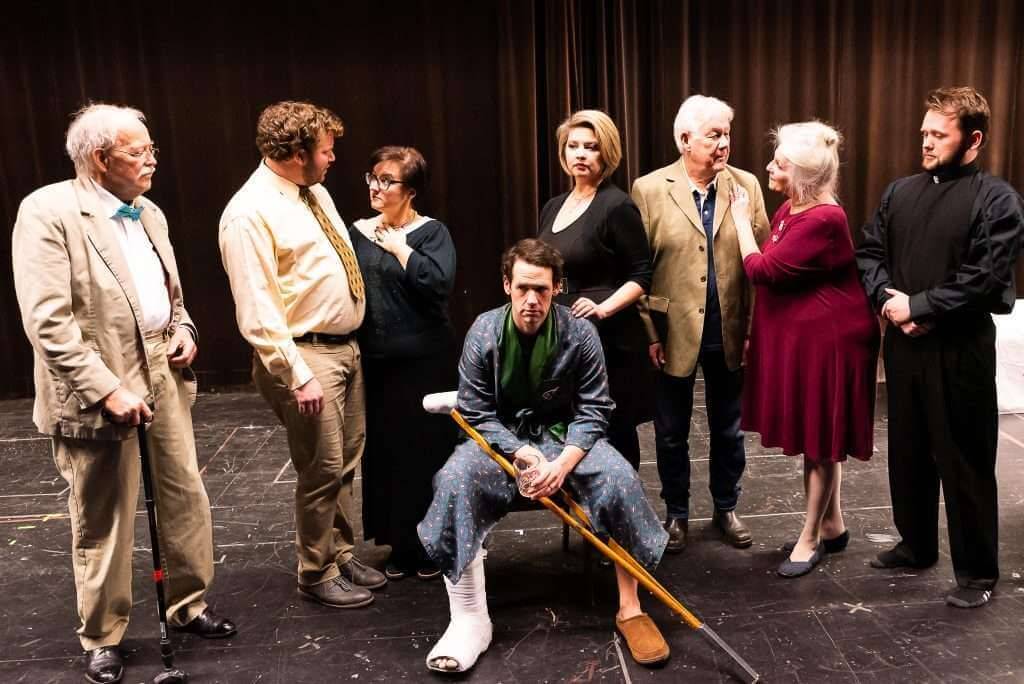
Cat on a Hot Tin Roof
ACT (a community theatre)
The Guild, Charlottetown
January 17, 2025
When PEI community theatre pillar ACT launched its 30th anniversary season with Cat on a Hot Tin Roof, my wife and longtime theatre companion Carol was so excited she urged me to review it regardless of time or date, skipping our usual scheduling back-and-forth entirely. Said Carol, “I never turn down Maggie the Cat!”
The play started as a 1952 short story (“Three Players of a Summer Game”) by Tennessee Williams, who converted it into a Pulitzer-winning stage play that premiered in 1955. It’s since been remounted repeatedly around the world and adapted for film multiple times.
It’s the tale of a wealthy Southern plantation family, the Pollitts, celebrating the birthday of ailing patriarch “Big Daddy” Pollitt (played in the ACT run by its director Paul Whelan) while they discuss his health and other concerns, notably the troubled marriage of his favourite son Brick (Adam Gauthier), an injured ex-athlete turned mopey alcoholic, and Brick’s estranged, vocally love-starved wife Maggie (Teresa Wright). Brick is also suspected of having had a gay romance with his deceased best friend Skipper, which Brick fiercely denies.
Seeing the play for the first time in years, I was struck by how much the 1958 film version excises the play’s gay content; how clearly the play’s gay subplot echoes Lillian Hellman’s 1931 play The Children’s Hour; and how Williams’ play no longer feels quite as transgressive, subversive or sensational as it once did in terms of its sexual content.
The ACT production’s artfully eye-catching poster trumpets the show’s “shock and fervour”; but while Williams’ intense characters still supply the fervour, the show’s not as shocking now as it would have been in the 1950s, nor even as daring as it seemed in the 1990s when I first encountered it.
Sex talk such as Maggie’s openly frustrated lust, Big Daddy’s leering lechery or the late Skipper’s self-loathing homosexuality feels less novel today; and as groundbreaking as they once were, The Children’s Hour and Cat on a Hot Tin Roof both see gay content through a retro cautionary lens. Both plays feature close friends accused of gay romance, both pairs deny it, both cases turn out to be half-true when one half of the duo realizes he or she may be gay, and in each play the gay friend spirals into self-destruction. To be fair, some of Williams’ characters seem surprisingly broad-minded regarding homosexuality; but regardless, these are plays from different times with different attitudes.
That said, while Williams’ play has lost a little of its salacious kick over the decades, it’s no less steeped in humanity and heart. The Pollitts are all distinctive, complicated, messy and moving characters: Maggie’s volatile mix of calculated guile and genuine heartbreak, Big Daddy grappling with mortality, Brick longing for the liberty of numbness, matriarch Big Mama (Barbara Rhodenhizer) lost in a fog of denial and devotion, Brick’s successful older brother Gooper (Mike Mallaley) all too aware of how little his family loves him, his scheming wife Mae (Amanda Rae Donovan) relentlessly coveting the family fortune.
Whelan’s cast—also including Aidan Gallant & Terry Pratt as visitors Reverend Tooker & Dr. Baugh—is lavishly stacked with some of the best and most accomplished actors in PEI community theatre, some of whom have worked with ACT for decades.
The talented, appealing Gauthier/Wright duo are somewhat uneven as Brick and Maggie—Wright takes a while to hit her stride opposite Gauthier’s suitably muted Brick early on, though she’s livelier as the play’s clashes escalate—and not all of the cast’s southern accents are created equal (Gauthier and Mallaley sound especially generic at times); but Whelan’s crowd-pleasing curmudgeon Big Daddy elicits both pathos and laughs, Gallant is amusingly awkward as Tooker, Mallaley brings poignancy to the unloved Gooper, and Rhodenizer steals the show as an achingly sad Big Mama. Performances like that and the enduring appeal of the play’s colourful, crackling and commendably humane script help ensure there’s far more than nine lives left in Williams’ much-loved theatrical cat.