
Bird on a wire
The Nature of PEI by Gary Schneider
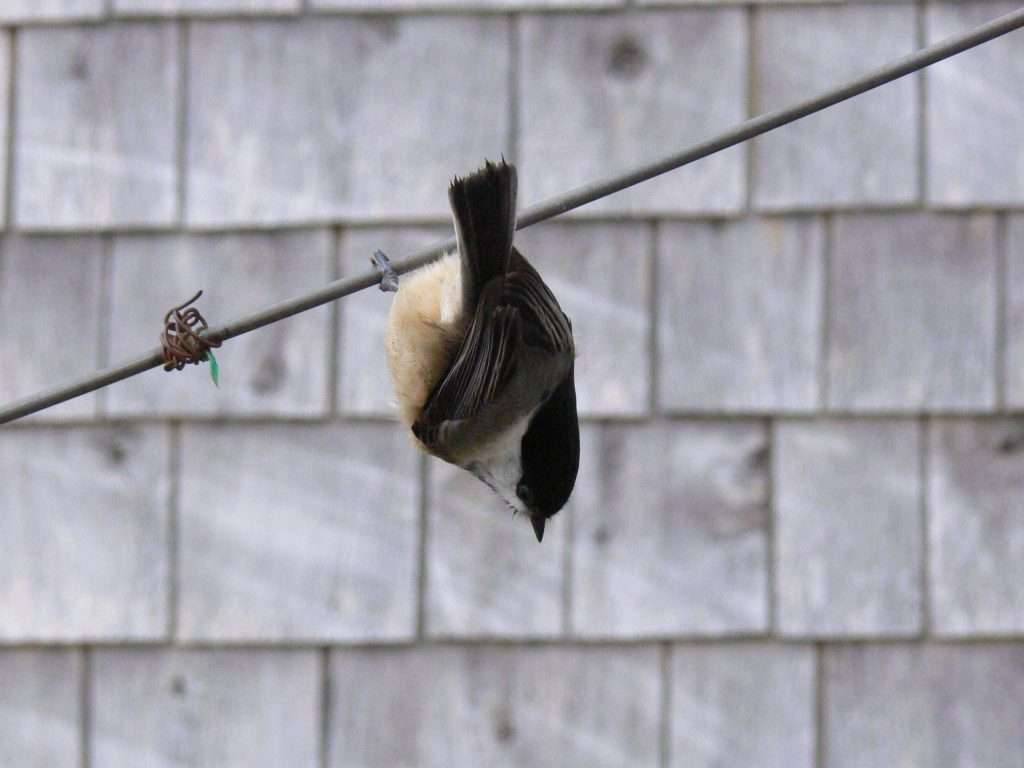
Last month I took in the fabulous Harmony House production, The Leonard Cohen Songbook. It was an excellent evening, top quality all around. When I heard Amanda Jackson’s powerful voice singing “Bird on a Wire,” I immediately thought it was perfect for my next nature column.
Identifying birds—or anything, really—is all about finding clues. Is there something unique about what you are seeing: a brilliant colour, huge size, webbed feet, or long tail? Is it on a beach or in the forest? Is it making noise, or keeping silent?
Only some species are regular wire perchers, and it can be an aid in identification. Before I get into identification, three questions are often asked.
The first is why don’t birds’ feet freeze when standing on a wire in the winter? If we stood on a wire in freezing weather, we’d be in trouble. But birds have natural heat exchangers, where the cold blood returning from feet is warmed by blood flowing from the heart. As it passes, heat is exchanged. A pretty neat process, and I wonder if that is where the idea of heat exchangers came from.
The second is why birds don’t get electrocuted when they stand on power lines. The sad thing is that occasionally they do, but only when they are on the line and in contact with equipment or something that is grounded. Just being on the line itself doesn’t cause any problems.
And finally, why do birds perch on wires, sometimes in harsh conditions. You’d think it would be the coldest place you could find on a windy, wintry day and it makes it easy for predators to spot you. One reason is that some are themselves predators. You’ll often see American kestrels sitting on a wire looking for prey in the fields below. Other predators that make use of wires include red-tailed hawks, rough-legged hawks, and northern shrikes.
The second reason is that many birds that flock together like sitting together. That’s why we see huge flocks of starlings sitting together on wires. We can also see snow buntings in the winter, and swallows in the fall. In addition, smaller numbers of mourning doves, crows and grackles can often be found on wires.
But back to the clues. If you see hundreds of birds together, especially if the flock has lifted off the ground, they are generally starlings. If you see one or a few big black birds on a wire, it is usually—but not always—a crow. I remember a time heading up to Robinson’s Island on the causeway where I saw a “crow” that just was sitting differently. I took the time to stop and was rewarded with a great sighting of a “dark-morph” rough-legged hawk.
If a bird on a wire is singing a mournful tune (perhaps Leonard Cohen-ish) that resembles the call of a barred owl, it is a mourning dove.
In the summer, most of our American kestrels are seen on wires, patiently waiting for mice, voles, grasshoppers or even butterflies to come within striking distance. Kestrels are our smallest falcons, but they are predators for sure.
Blue jays are often seen perching, but they are not the only blue-feathered bird that you can see on wires. Eastern bluebirds love to perch, and although rare, they are regularly spotted across the province.
If you are interested in birds, it is worth keeping an eye on the wires as you (carefully) wander the roads of PEI.
Thanks to Leonard Cohen and Amanda Jackson for the inspiration.