
A special visitor
The Nature of PEI by Gary Schneider
Watching birds is a growing pastime on Prince Edward Island. Once upon a time —let’s say 40 years ago—there was an active Natural History Society of Prince Edward Island that today exists as Nature PEI. There were many good birders involved in the organization, but without the numbers that we have today.
Part of the growth involves the internet. Who would have predicted that almost everyone and their brother would have the Merlin app on their phone these days? Knowing nothing about bird calls, you can turn on the app, wait for a bit, and then it gives you a list of the birds it hears in the area. What a great way to learn!
There are also tons of online courses from Cornell University and other outstanding sites where you can learn the intricacies of gull identification or how to tell one species of confusing fall warbler from another. Much of the online material is free—including hundreds if not thousands of videos that are produced by excellent birders from around the world. And the Sibley series of identification books has really been a boon to those trying to elevate their birding skills.
As much as I love getting out to see birds, I’m especially over the moon when they come to visit me at my home. Over the years in Tea Hill, there have been Northern cardinals, a pileated woodpecker, barred owls, several saw whet owls, evening grosbeaks, and many other species that kept me glued to the windows watching the feeders.
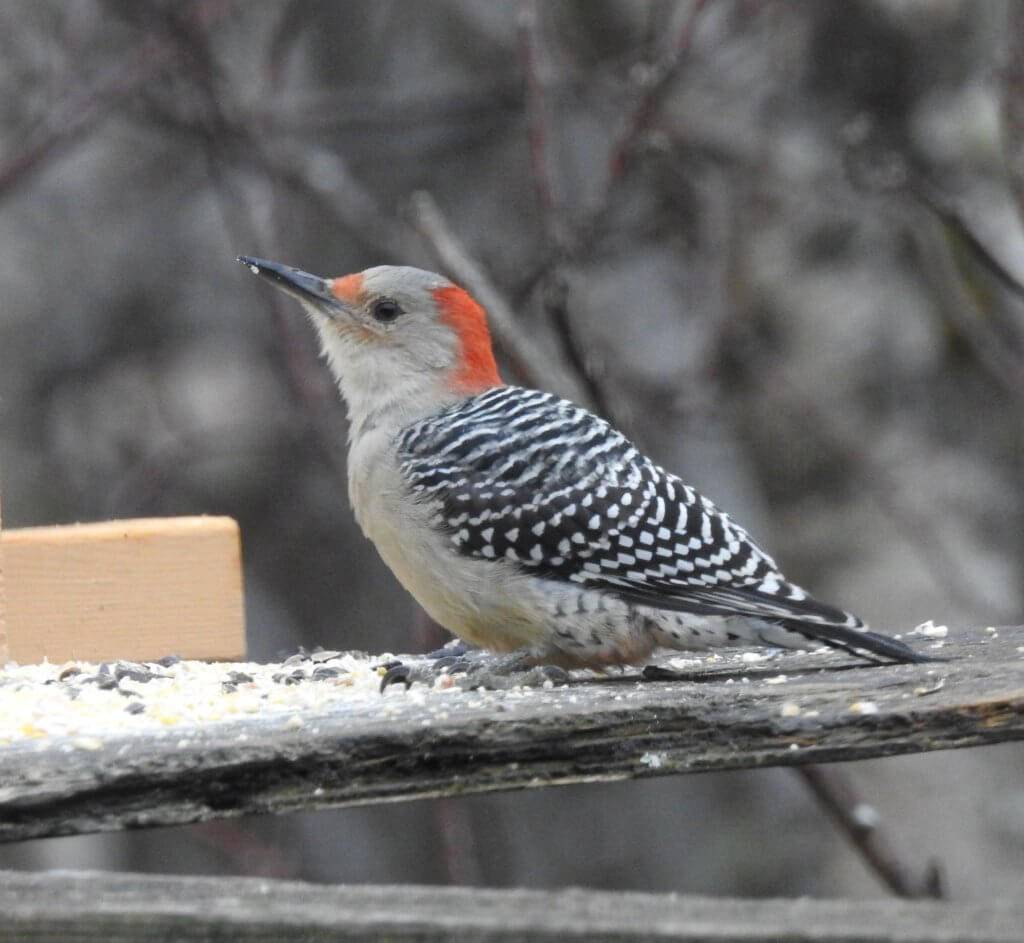
This year there has been a special visitor for the past two months—a female red-bellied woodpecker. I find all woodpeckers to be very interesting birds. The fact that they almost single-handedly teach valuable lessons about the importance of dead trees (where they create cavities for nesting) makes them winners in my book. They are also lovely birds, especially if you get a close look at them.
These woodpeckers are a little smaller than a robin. The back is black and white but more heavily patterned than most woodpeckers. The male has a beautiful red crown that runs down the back of the head. The females, on the other hand, only have red at the back of the head and not at the crown. Both sexes have pale, slightly red bellies.
The Tea Hill visitor has really been going at the suet feeder and chowing down on both the black oilseeds and cracked corn. They will take peanuts and fruits at feeders and also eat spiders and small insects.
This is one of nine species of woodpeckers that you may be able to see in the province. Some, like the downy and the hairy, are common around feeders and are here year-round. Others, like the yellow-bellied sapsucker, mainly migrate to us from the south in late spring. The red-bellied woodpecker used to be a rare sighting and is still listed in the PEI Field Checklist of Birds as Occasional (spring), Accidental (summer), and Rare (fall and winter). It is a bird of the southeast part of the continent, though it is locally becoming increasingly common.
Besides Tea Hill, they’ve been sighted in other places recently, including Orwell and Marshfield. While there are no reports of them nesting in the province, that may change as the range of these birds expands. They will nest in cavities they make in dead or dying trees if they do decide to take up permanent residence here.
For now, we’ll just be happy to see them whenever they visit our area.