
A happy ending?
Review by Norah Pendergast
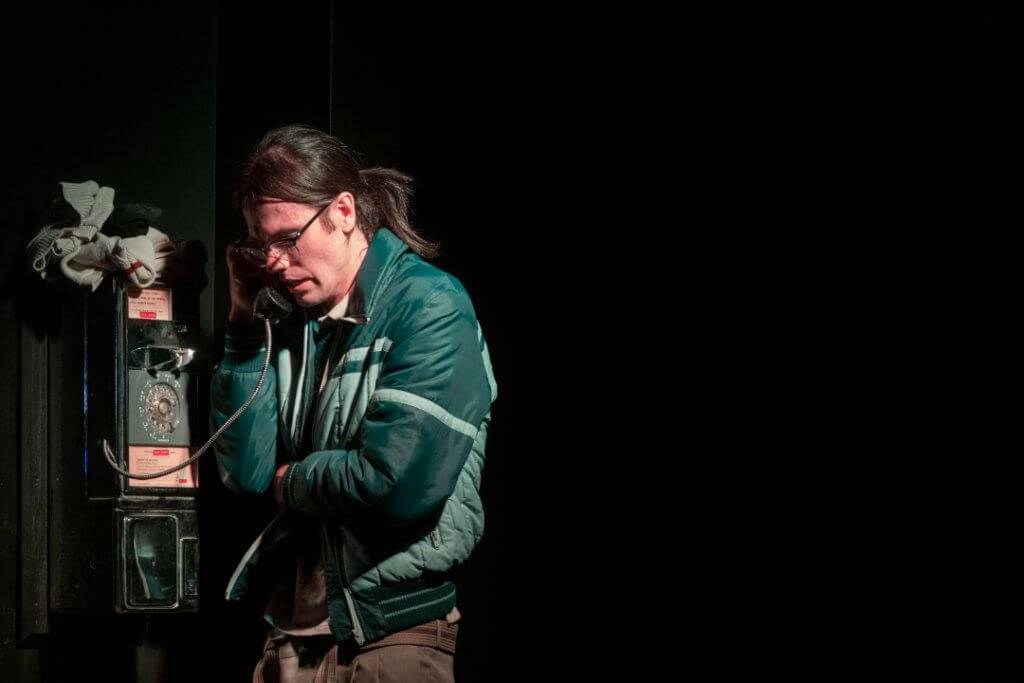
333: The Toronto Bathhouse Raids
The Arts Guild, Charlottetown
June 19,2026
In the beautifully restored Arts Guild Black Box, audiences were transported back in time to a transformative historical moment in 333: The Toronto Bathhouse Raids, written by Jay Whitehead and directed by GaRRy Williams. The play is on an Atlantic Canadian tour that includes stops in Parrsboro, Sackville, New Brunswick, and Halifax, and is featured in Charlottetown as part of The Arts Guild’s series of summer shows, Rooted and Rising.
The play is set in 1981 and focuses on the events of Operation Soap, the Toronto Bathhouse Raids, when over 300 men were arrested and charged with being found in a “common bawdy house.” At that time, it was the largest single arrest in Toronto’s history, but most of the men were eventually found innocent. The police brutality sparked outrage among Toronto’s gay community and unified an uprising that would evolve into our contemporary tradition of Pride events.
333 stars Jay Whitehead as “Honey,” a truth-telling oracle who paces brilliantly comedic zings with tender joy and pain. Whitehead delivers fantastically in this role as an aging drag queen who has committed to living authentically, despite being marginalized even within the gay community.
“Darren,” an elementary school teacher played by Calgary’s John Tasker, is convincing as a straight-passing, first-time visitor to the titular bathhouse. Darren has an envy/pity/disgust relationship with the other characters, and with the freedom that comes with their commitment to living authentically, despite the sacrifices they make to do so. He connects with rugged working-class immigrant Eddy, played by Halifax’s Diego Guerrero, who offers to make his dreams come true. Viewers are ushered into the bathhouse with Darren and, through him, learn its etiquette, including supportive, consent-forward relations that are sometimes contrasted with violent aggression.
The subconscious is an active plot force, driving the hateful motivations of persecutors, counterintuitive objects of desire, and self-loathing that erupts into lateral violence. Dylan Brentwood, the violence and intimacy coordinator, facilitated one of the most impressive moments: a lustful dream sequence, augmented by sound, light, and perfect choreography, that released the writhing psyches from their masked waking world.
The pressure of a believable cover is relatable to most people who must mask to navigate their daily roles and survive, and audiences also share the catharsis when Honey, politicized by having nothing left to lose, courageously marches with a sign reclaiming a homophobic slur from her oppressors.
Costume Designer Diego Cavedon-Dias situated the play in the early 80s through attire that signaled each character’s position—the lavish loungewear of Queen Honey, the straight-passing plaid and corduroy of Darren, and the Freddie Mercury–esque style of Eddy.
Ian McFarlane (of the River Clyde Pageant) provided set and lighting design, economical components that maximized the small space and brought the script to the next level. Effectively supporting “imagining backwards,” the ephemera of memory and gay lust were represented in McFarlane’s expressive, loosely painted imagery.
Aaron Collier composed a sophisticated sound design that amplified audience heart rates in empathic pulses along with the well-paced rise and fall of intensity on stage.
The diverse identities of the three characters illustrate the intersectional and layered psychic responses to living under institutionalized homophobia: either sacrifice authenticity and live closeted, or come out as gay and be denied humanity. The play is about the question, “Who am I?” in this historical Canadian context.
The play, Honey explains, is a product born out of “the justice drive” of many artists, suggesting that Canada’s history of hate and persecution can be somewhat healed through queer (and other oppressed people’s) storytelling. Near the conclusion, Eddy laments that the community that grew out of the bathhouses has been replaced today with apps and social media. Is there a happy ending? Time will tell.