
A haunting in North Rustico
Review by Sean McQuaid
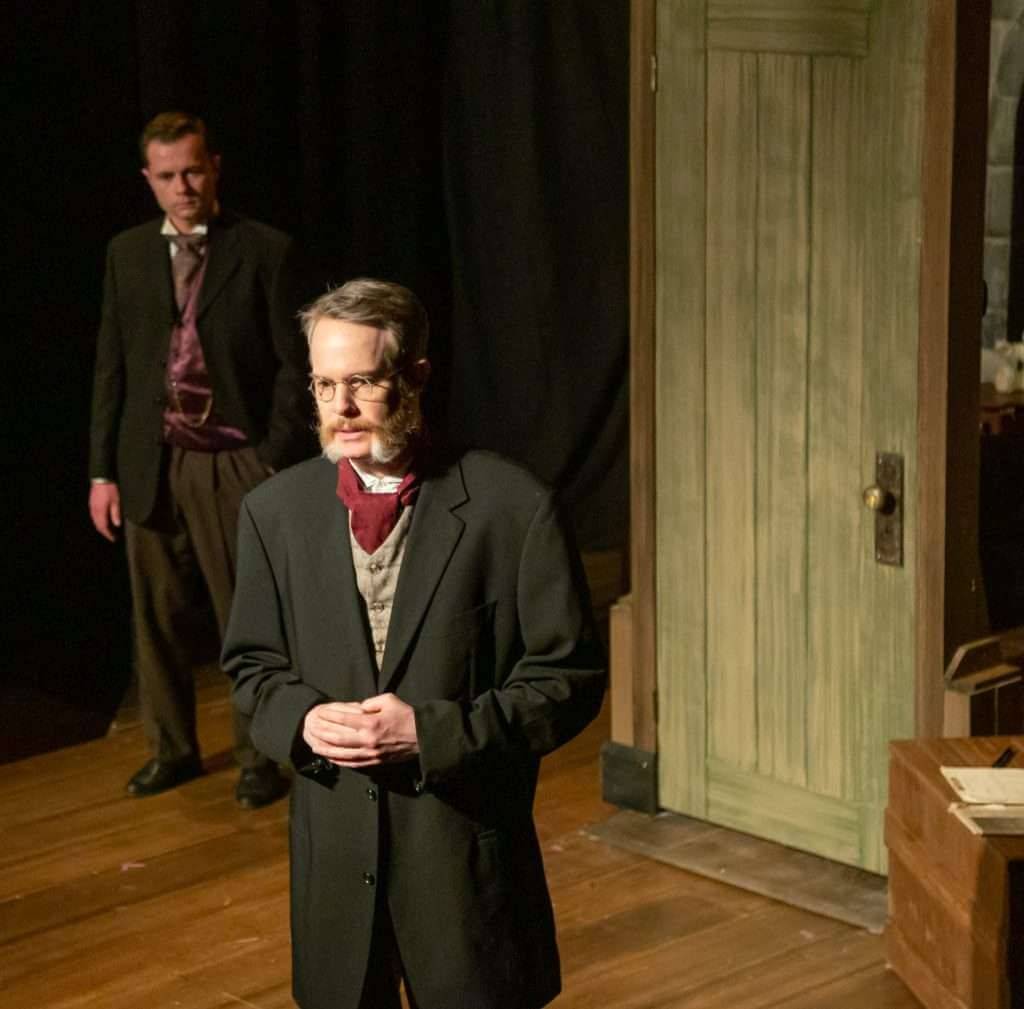
Woman in Black
Watermark Theatre, North Rustico
July 14, 2025
I’ve always liked ghosts. I may have met one once, a long time ago in a place that no longer exists; but mostly I just see them in books, movies, dreams—and sometimes, on stage. Theatres are perfect places for ghosts, dark spaces steeped in imagination and thick with memories of innumerable stories, characters and performers.
The Watermark (originally the Montgomery Theatre) is relatively young, so it hasn’t as many real-life ghost stories as some of its older peers, like the historic Kings Playhouse in Georgetown; but its North Rustico stage has hosted some of my favourite spectral spectacles, like 2011’s hauntingly superb An Inspector Calls or Rex McCarville’s indelibly chilling 2015 turn as Jacob Marley’s ghost in A Christmas Carol.
The venue has fielded further phantasms since then—ACT’s West Moon and The Weir, multiple versions of A Christmas Carol—and is swooping back into supernatural territory with this summer’s The Woman in Black, an enduringly popular theatrical ghost story.
Originally a 1983 gothic horror novel by UK writer Susan Hill, The Woman in Black was adapted repeatedly for TV, radio and film. Hill’s tale of a young lawyer’s supernatural travails at an isolated English country estate was adapted for the stage in 1987 by Stephen Mallatratt. The show’s West End run lasted 33 years and over 13,000 performances before giving up the ghost in 2023.
Mallatratt’s adaptation boils the story down to a tiny cast in a single set by converting Hill’s plot into a play-within-a-play staged at a Victorian theatre. In this version, many years after his ghostly misadventure, lawyer Arthur Kipps teams with an unidentified professional actor to stage a play about it in hopes of putting his fears behind him. “I cannot carry the burden any longer,” says Arthur. “It must be told.”
In this play-within-a-play, the actor plays Kipps and the real Kipps plays the supporting roles. Since their rehearsal fills most of Mallatratt’s text, the professional actor is identified as “Kipps” in the script and in the Mallatratt play’s credits, while the script and credits call the real Kipps “The Actor” in an odd reversal or blending of their true identities.
Watermark’s production, starring Brandon Stafford as “Kipps” and Paul Van Dyck as “The Actor,” is directed by Rahul Gandhi and designed by Sabrina Balliana (set/costumes), Rehan Lalani (sound) and Ryan Rafuse (lighting). It’s a deft, atmospheric rendering of the Hill/Mallatratt tale, albeit more often eerie than scary.
The underlying story remains a solid chiller—Kipps visiting a seaside country town to settle the estate of a recently deceased reclusive old widow, her weird old misty marshland house reachable only by a causeway that disappears at high tide, the house and town haunted by a bleak, black wraith of “desperate, yearning malevolence”—but the Watermark version’s horror feels a bit muted in spots.
The Watermark’s small playing space is a factor, but only slightly; Mallatratt’s play has graced widely varied venues, after all, and was first staged in a British pub. As “Kipps” tells the real Kipps regarding parts of the story they lack the resources to show, the key is the imagination of both performers and audience. Stafford excels in this regard. When as “Kipps” he struggles desperately to save a dog from drowning in the marsh, there’s no dog, no marsh, no nothing, just Stafford flailing and pleading, but the moment is disturbingly effective because he sells it with such anguished feeling.
Stafford is the show’s strongest asset in this vein, reinforcing the story’s tenuous meta-theatrical reality through sheer, vivid force of personality, whether as the cocky unnamed actor or the callow fictional “Kipps.” Van Dyck is often quite good as the sympathetically sadder-but-wiser true Kipps, though his supporting parts as “The Actor” blur together a little at times.
The thrust stage’s conflicting sight lines feel a bit tangled, but the show is technically strong for the most part: the set’s understatedly creepy mix of theatre and haunted house elements, the well-deployed fogs and mists, the period costumes, the evocative lighting, a menacingly lush soundscape, some old-fashioned jump scares and low-key special effects all dial up the spookiness. And who or what is that dark lady we glimpse in the shadows? As “Kipps” warns us, “Such things one must face.”
Performances of The Woman in Black run until August 29. For tickets, visit locarius.io/organizations/26 or call the box office at 902-963-3963.